
Top IPTV Trends to Watch in 2026: The Future of Streaming
2026 is the definitive tipping point. Traditional broadcast television has been fundamentally outpaced by internet-protocol architectures, and the technologies reshaping how global audiences interact with live video feeds are accelerating faster than ever. This report delivers an insider's look at the five defining iptv trends 2026 that every cord-cutter, digital entrepreneur, and entertainment enthusiast must understand.
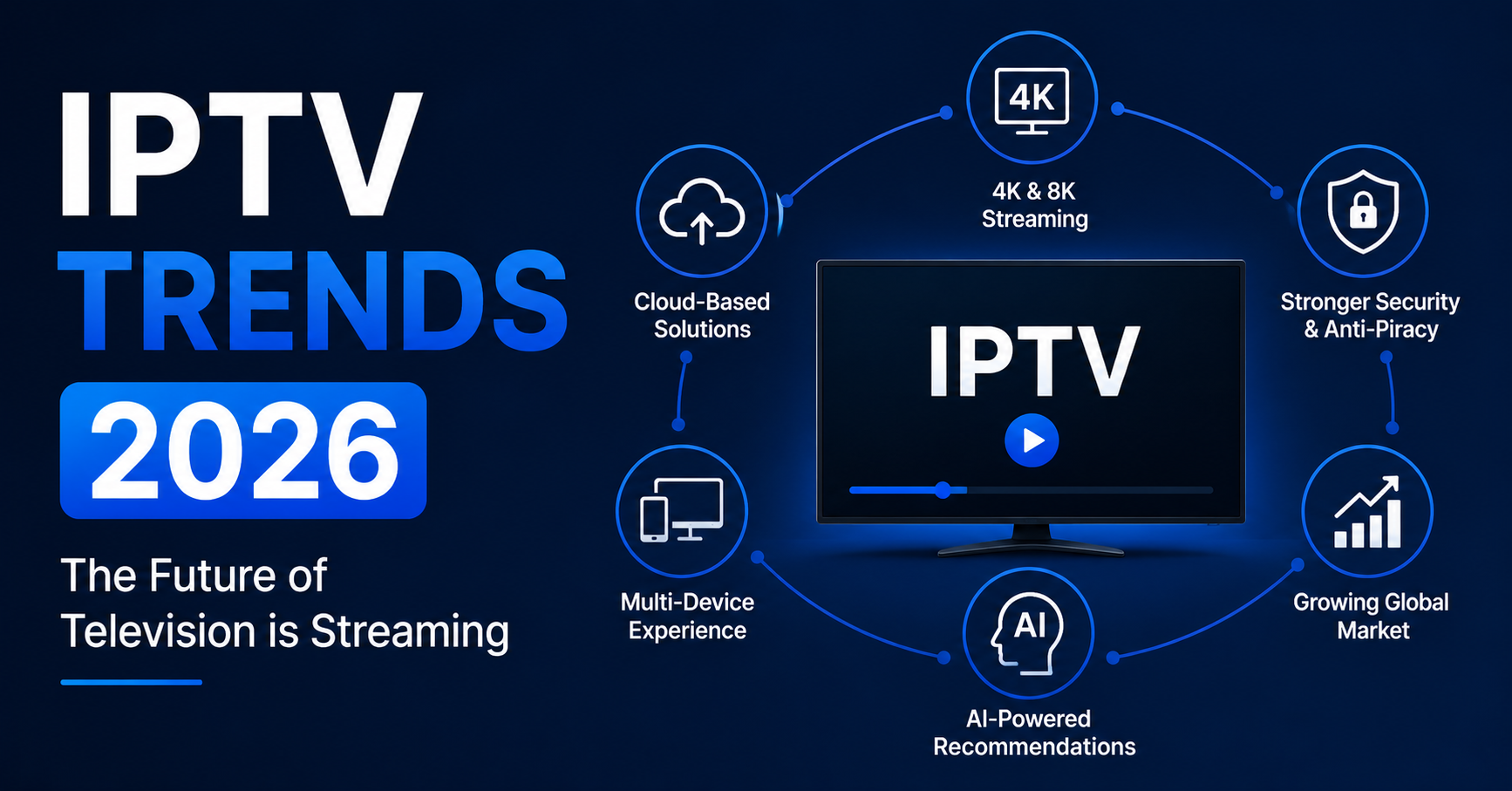
Trend 1: Widespread Adoption of AV1 and Next-Gen Codecs
For years, the streaming industry has leaned on H.264 and, more recently, H.265/HEVC to balance quality against bandwidth. Both are mature standards, but they carry licensing baggage and diminishing efficiency returns. Enter AV1 andH.266/Versatile Video Coding (VVC) — the first codec generations designed from the ground up for the hyper-efficient delivery of 4K and 8K content over consumer-grade internet connections.
AV1, developed by the Alliance for Open Media, is royalty-free and already baked into the latest generation of Smart TV chipsets, Fire TV sticks, and Android TV boxes shipping in 2026. Its key advantage is a ~30% bit-rate reduction versus H.265 at equivalent perceptual quality. This means a provider can serve pristine 4K HDR at 15–20 Mbps — a speed easily achieved over a standard 50 Mbps fibre link. H.266/VVC goes even further, targeting another ~30–50% compression gain over AV1, though its hardware decoder support is still rolling out across premium devices.
For consumers, the practical impact is dramatic: fewer rebuffering events, faster channel-switch times, and the ability to watch ultra-high-definition content on connections that previously struggled with 1080p. The best next gen streaming video codecs are no longer a future promise — they are shipping today. Providers who have upgraded their encoding pipelines to AV1 are already seeing measurable improvements in viewer retention and average session length.
Trend 2: AI-Driven Load Balancing and Edge Computing Networks
Server infrastructure has undergone a quiet revolution. The old model — a centralised cluster of streaming servers behind a CDN — simply cannot keep up with the spike-driven demand patterns of live television. An international football final can see 10 million concurrent viewers converge on a single channel in under 30 seconds. Legacy infrastructure buckles. The new standard is adecentralised edge node architecture controlled by machine-learning scripts that predict traffic surges before they happen.
Here is how it works. Historical viewership data, combined with real-time signals like social-media engagement velocity and calendar event triggers, feeds into a predictive model that continuously adjusts routing tables. When the model detects a high-confidence surge window — say, kick-off for a Champions League match — it pre-populates edge nodes in the affected geographic regions with the relevant video segments. When traffic hits, viewers are served from the nearest warm cache rather than being routed back to an origin server halfway around the planet.
The result is a viewing experience defined by stability. Bit-rate negotiation happens at the edge, not the core. Buffer bloat is eliminated. Channel-switch commands are executed in under 200 milliseconds. For the subscriber, this means future of live tv broadcasting that finally feels as responsive as traditional broadcast — without the latency penalty that plagued early IPTV deployments.
Trend 3: Hyper-Personalized Ecosystems and Interactive Streams
User interfaces are undergoing a fundamental re-architecture. The static, one-size-fits-all channel grid is giving way to dynamic, server-side personalised ecosystems that adapt in real time to individual viewing behaviour. This shift is powered by three converging capabilities:
- Instant multi-angle sports feeds — Premium providers now bundle 4–8 camera-angle streams for major live events. Machine vision algorithms automatically cut to the best angle based on play context, and viewers can switch angles manually without any channel-change delay.
- Automated personalised channel line-ups — Rather than scrolling through 20,000 channels, the system analyses your watch history, time-of-day patterns, and genre preferences to surface a tailored live grid. Categories you never watch are collapsed; new content matching your tastes is promoted.
- Ultra-fast dynamic Electronic Program Guides (EPG) — EPG data is no longer a static XML file delivered once daily. It is parsed dynamically from the edge, refreshed in near-real time, and filtered on the server side so your device never has to process guide data for channels that do not interest you.
These features collectively reduce interface lag, improve content discovery, and create a television experience that feels as intuitive as a modern music streaming service. The age of the passive, linear channel-surfing experience is over.
Trend 4: Advanced Privacy Protections Built into Streaming Protocols
As internet service providers deploy ever-deeper packet inspection technology, consumers are increasingly aware that their viewing habits are visible to third parties. Premium IPTV providers have responded by weaving privacy protections directly into the streaming protocol layer, eliminating the need for a separate VPN or proxy tunnel.
The architecture works like this. Stream segments are encrypted at the encoder using per-session AES-256 keys. The key exchange occurs inside a TLS 1.3 tunnel that is established before the first video frame is transmitted. Crucially, the DNS resolution for the streaming endpoint is handled by an encrypted resolver (DoH or DoT) integrated into the player application itself, meaning your ISP sees only a connection to a generic CDN endpoint — not a specific channel or stream URL.
For the av1 protocol media delivery stack, these protections are particularly important. The higher computational efficiency of AV1 means the encryption-decryption cycle imposes negligible overhead on the decoding pipeline. Viewers get the privacy of a fully encrypted tunnel without the CPU drain that older codecs would suffer. The result is a streaming environment where security is not an afterthought or an add-on bolt — it is a foundational property of the data path.
The Strategic Call-to-Action
Keeping pace with the future requires an infrastructure built for tomorrow. The five trends outlined above are not theoretical — they are being deployed right now by the most forward-thinking streaming operators in the world. But technology at the edge is only as effective as the platform that orchestrates it.
Our premium subscription platform is engineered as the definitive industry standard for 2026. Every stream runs through a fully optimised next-gen codec pipeline supporting AV1 and H.266. Our server fabric is a global, AI-orchestrateddecentralised edge node architecture that delivers anti-freeze performance even during the most extreme live-event traffic spikes. And our software architecture is future-proof — built from the protocol layer up to support hyper-personalisation, interactive streams, and native privacy protections without compromising on speed.
Experience the Cutting Edge of Streaming
Stop watching yesterday's technology deliver tomorrow's content. Join the subscribers who already enjoy the fastest, most private, and most personalised IPTV experience available in 2026.
Key Takeaways
- AV1 and H.266/VVC are the dominant next gen streaming video codecs of 2026, delivering 4K/8K at 30–50% lower bit-rates than H.265
- AI-predictive edge caching and decentralised edge node architectureeliminate buffering even during 10-million-concurrent-viewer live events
- Hyper-personalised ecosystems — multi-angle sports, auto-curated grids, and dynamic EPG — are replacing the static channel grid as the default UX paradigm
- Privacy protections are now baked into the av1 protocol media deliverylayer, with per-session AES-256 encryption and encrypted DNS — no separate VPN needed
- The future of live tv broadcasting belongs to platforms that integrate all five trends into a single, cohesive infrastructure. Compare our offering at our plans page or explore the supported applications
Related Articles
Anti-Freeze Technology: How We Ensure Stable Streaming
Deep dive into the adaptive bitrate and load-balancing systems that keep streams stable at scale.
How to Protect Your Privacy While Streaming IPTV
Comprehensive guide to encrypted streaming, ISP bypass techniques, and protocol-level security.
The Legal Aspects of IPTV: What You Need to Know
Understanding the regulatory landscape surrounding modern IPTV services.